
A companion to Application What-the-Fucks. Where the last post was about the grind of applying, this one is about what happens when you finally get in the room — and the room doesn’t show up.
The Interview
I went in excited. Great phone screen. I’d done a deep dive on the company, and this round was supposed to be about the role — conversational, maybe a bit technical.
The decision had already been made.
A dude greeted me and asked me to turn on my camera, with a tone hard to miss. It had been on. Maybe they’re screening for AI slop, but come on — read the room. We’re all in this together.
My name is [dude], and I have a bunch of development teams here at [company], including QC and other teams. I’ve been with [company] for eleventy-plus years. Any others?
No context. No warmth. Nothing about the role. I have no idea who this person is.
Two more people chimed in from the void, cameras off for the duration:
Yeah, hopefully you have the skills we need. Good luck.
Good to meet you. Good luck.
I’ve never been wished “good luck” in an interview. Twice? I introduced myself and waited for the conversation to start.
It didn’t.
The First Question
I see you’ve moved around quite a bit. Can you explain why there is so much job changing?
Right out of the gate. No transition, no curiosity — just suspicion, poorly phrased.
I answered. Two layoffs during industry-wide cuts. I offered timing, context, and impact. Silence. I waited a beat, then filled the void — I’d stepped away from work to take care of my father. More silence. We moved immediately to technical questions, and I understood: this wasn’t a conversation. It was a checklist.
That first question set the tone for the entire next hour.
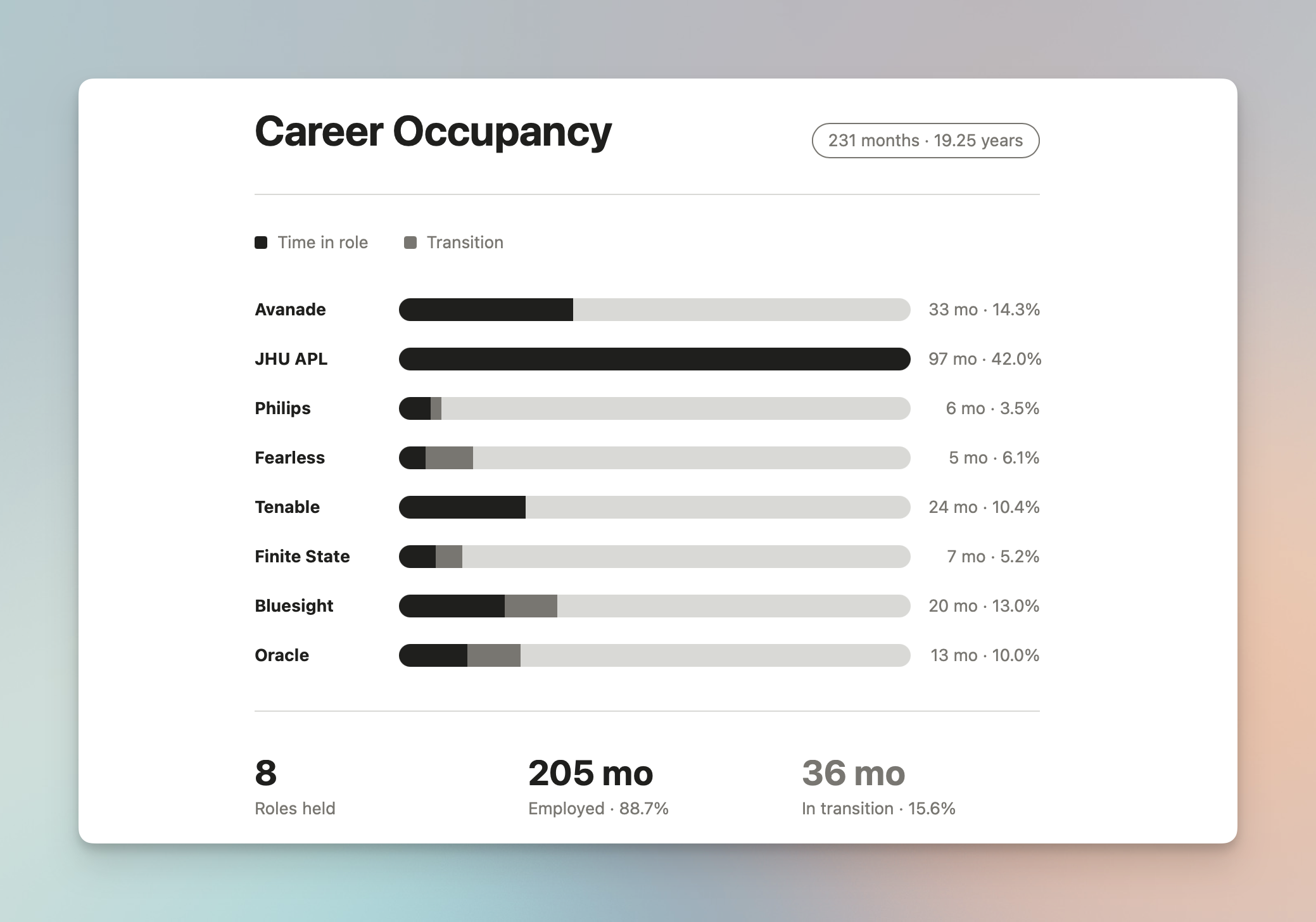
Career Occupancy
231 months · 19.25 yearsThe Trivia Gauntlet
The job description said distributed systems, observability, and modernization. The interview said SQL Server trivia and legacy reporting tools — delivered mostly to a second monitor off to the upper left, which held the [dude]’s attention for the entire hour like a siren song.
Have you worked in a SQL Server environment, used SQL Server Enterprise, or mostly used Oracle?
He read my resume enough to spot the gaps, but not enough to notice Oracle DB isn’t mentioned anywhere. My time at Oracle wasn’t even database-related. It contributed 12 of the 231 months I’ve been getting shit done.
So, did you work with a setup called Availability Groups?
Do you have any reporting experience?
What about stored procedures?
And then, the one that made me chuckle out loud:
Do you have any experience with Crystal Reports?
Actually, yes, in high school. It came with VB6. What the fuck is happening right now?
Every answer got the same response: “Okay.” No follow-ups, no curiosity, no engagement. They asked one question about Azure. One question about DevOps — and when I explained my work advocating practices that make other developers’ jobs easier, nobody asked what those practices were. A normal conversation would’ve gone somewhere with that.
It was the three of them asking a question, listening to my response, and checking a box. I had no idea how many boxes there were or where we were going.
What It Actually Was
This wasn’t an interview. It was a filter. They weren’t evaluating engineering judgment. They were checking for familiarity with a narrow, aging stack inside a process that assumed its own perspective was universal.
I think this is more common than people realize, and it requires real introspection to recognize in yourself:
- Local experience mistaken for general expertise. Settling for “built here” shrinks what’s possible.
- Internal systems mistaken for industry standards. Look beyond company norms.
- Trivia mistaken for capability. ChatGPT knows a lot of trivia. I know how to get shit done.
The voids mimicked the leader’s interview mechanics and tone exactly. He built his teams in his own image. “Good luck, Matt. If you have a certain set of skills, you can become one of us.”
The Withdrawal
It was 4am. I withdrew my application. I didn’t expect anything to come of it, but I wanted to signal something. I replied to the full panel and HR:
After reflecting on our conversation, I don’t think this is the right fit for me. The interview experience didn’t align with what I look for in a thoughtful and collaborative engineering environment, which was disappointing given my initial interest in the role.
The Call
This is the part I didn’t expect. The recruiter called and asked for feedback on their process. I was honest, and we shared perspectives. The title for this post was originally just a rant, and I was trying to turn it into something pragmatic when they called.
I told them that it felt like a decision had been made before I joined the call; that the questions didn’t match the role. That the format — no engagement, no follow-ups, no humanity — communicated more about the team’s culture than any answer I gave.
Our conversation was good, and I wished them good luck.
The Point
If you’re going to evaluate someone, at least meet them halfway. Show up. Turn your camera on. Ask questions and care about the answers. You pulled this candidate out of their day — more of it than yours, by far. Respect that.
I don’t mind hard interviews. I don’t mind missed questions. I don’t mind rejection for a good reason.
But there’s a real person on the other end of that screen. A guy with two daughters, AA meetings, and a lot of talent. A human being who prepared, who showed up ready to contribute, who deserved better than a trivia gauntlet delivered to a second monitor.
If it feels off, it’s off. Trust that. And if you’re on the other side of the table — don’t be a dick.
Leave a Reply